


Table of Contents
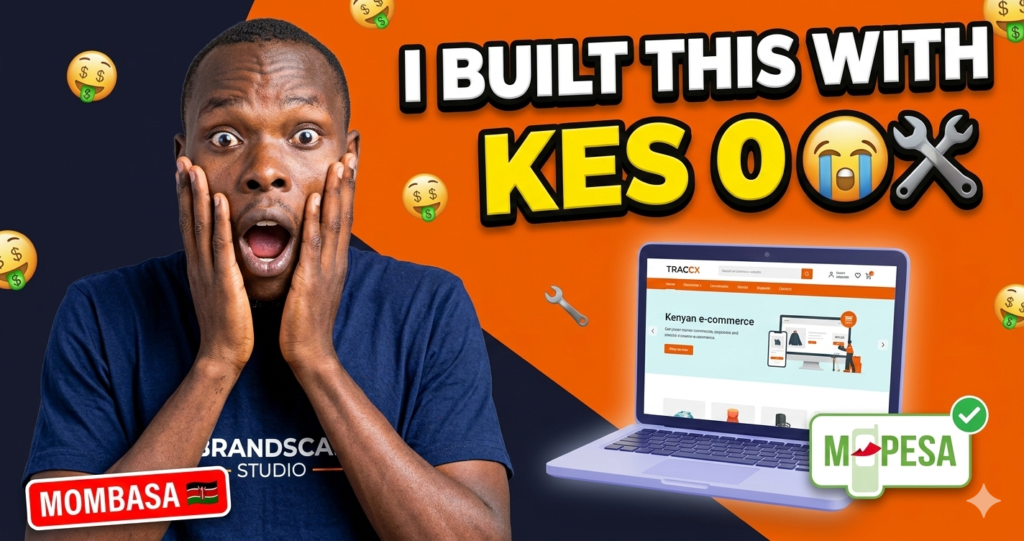
Building an online business Mombasa Kenya is not supposed to start with a mechanic laughing at you in a garage in Changamwe. But that is exactly where Traccx began.
It was not a lightbulb moment. There was no investor pitch, no big launch event, no team of developers sitting in a co-working space in Westlands drinking overpriced coffee. It was me, a laptop, a Safaricom line, and a problem I could not stop thinking about.
I was sitting with a friend — a mechanic who runs a small garage in Changamwe, Mombasa. He had just spent four days waiting for a brake caliper for a customer’s Toyota Fielder. Four days. The customer’s car sat on a jack in the sun. The customer called three times a day. My friend called every spare parts contact he had in Mwembe Tayari and Kirinyaga Road Nairobi. Nobody had the exact part. When it finally arrived it was the wrong side.
I asked him how often this happened. He laughed. Not a funny laugh. The kind of laugh you do when something is so consistently broken that frustration has turned into dark humour.
“Every week,” he said. “Sometimes twice a week.”
Four days. A car sitting on a jack. The wrong part arriving. And this was a normal week.
I went home that evening and started searching online for spare parts in Kenya. I found Jumia with a handful of listings. I found some Facebook pages with inconsistent stock and no prices. I found a few WhatsApp numbers that led nowhere. I found nothing that resembled a proper, trustworthy, searchable marketplace where you could select your exact make, model and year and see what was available, from which vendor, at what price, and order it right now with M-Pesa.
That gap is where Traccx was born.
Why I Was the Wrong Person to Build This Online Business Mombasa Kenya— and Did It Anyway
I want to be upfront about something. I am not a spare parts person. I have never worked in a garage. I do not know the difference between an OEM and an aftermarket part from memory. I had to learn what a CV joint was while writing the product categories for the website.
What I am is a digital strategist. I run Brandscape Studio, a creative and digital agency in Mombasa. I have built websites, run SEO campaigns, managed social media for brands, and helped Kenyan businesses grow online for years. I know how to build things on the internet. I just had to apply that knowledge to a problem I could see clearly — even if it was not my industry.
This is actually something I believe strongly. The best person to solve a market problem is sometimes not the industry insider. The insider knows too much about why it cannot be done. They have tried before. They are comfortable with the broken system. An outsider who understands technology and marketing sees the gap as an opportunity rather than a wall.
I saw a gap. I had the skills to address it. I was based in Mombasa — arguably the best city in Kenya to launch a spare parts marketplace given the port, the mechanics, the boda boda culture, and the underserved coastal counties. And I was unemployable enough in my stubbornness that once an idea takes hold I cannot leave it alone.
So I started.
Week One — The Chaos Phase
The first week was humbling.
I knew I wanted to build a multivendor WooCommerce marketplace. I had worked with WooCommerce before for single-vendor shops but a multivendor platform is a completely different animal. You need a plugin that handles vendor registration, individual vendor dashboards, commission splitting, payout management, and product approval — all on top of the usual WooCommerce complexity.
I chose Dokan. It is the most established multivendor plugin for WooCommerce and had a free plan that was genuinely functional rather than crippled. I installed it, activated it, and spent the next six hours reading documentation and undoing things I had done wrong.
Then there was Elementor. I was using the free plan and quickly discovered how many features require the Pro upgrade. The search bar widget — Pro. The WooCommerce product grid with filters — Pro. Half the widgets I naturally reached for — Pro. I had to build workarounds using the HTML widget for almost every section that required anything beyond basic layout. This forced me to write actual HTML and CSS inside Elementor, which turned out to be more powerful and more flexible than the drag-and-drop widgets anyway. But it was not what I expected at the start.
By the end of Week One I had a homepage that looked like a homepage, a shop page that sort of worked, and a vendor dashboard that confused even me. I deleted everything and started again.
I deleted everything and started again. Twice. The second restart was the one that became Traccx.
The Part Nobody Tells You About Building a Marketplace
Here is the thing about marketplaces that nobody who has not built one will tell you. A marketplace is not a product. It is not a website. It is a coordination problem.
A normal ecommerce store has inventory. You buy products, you list them, customers find them and buy them. Simple. A marketplace has no inventory of its own. The marketplace is empty until vendors fill it. And vendors will not join an empty marketplace because there are no buyers yet. And buyers will not come to an empty marketplace because there is nothing to buy.
This is called the cold start problem. Every marketplace in history — from Amazon to Jumia to Airbnb — has had to solve it. The way you solve it is by being obsessed with the vendor side first. Forget buyers for the first month. Get vendors. Get inventory. Get real products with real prices listed by real people in your city. Then the buyers have a reason to come.
I spent three weeks physically walking Mwembe Tayari and the Changamwe garage belt before I ran a single piece of buyer-facing marketing. I introduced myself to dealers personally. I showed them the site on my phone. I walked them through the vendor registration process on the spot. I answered every question they had — about commissions, about payouts, about what happens if a customer complains, about who handles delivery.
Some of them signed up immediately. Some of them said they would think about it and never called back. Some of them called their friends over to hear the pitch and I ended up registering three vendors in one afternoon from a single introduction. The ground game worked. The WhatsApp messages to strangers did not.
The SEO Obsession
I am an SEO person by profession so naturally I could not just build the site and launch it. I had to make sure every single page was optimised before a single product went live.
I used Rank Math on every page. Not just the homepage. Every page — FAQ, Returns Policy, Contact, Report Counterfeit, Affiliate Program, the vendor pages, the category pages, the blog. Every page got a focus keyword, an optimised SEO title with the keyword at the start, a meta description with the keyword in the first sentence, and enough body content to give Google something substantial to index.

The focus keywords I chose were all long-tail and all Kenya-specific. Not just ‘spare parts’ — that is impossible to rank for globally. Instead: ‘genuine spare parts Kenya’, ‘buy spare parts online Kenya’, ‘Toyota Fielder spare parts Mombasa’, ‘report counterfeit spare parts Kenya’. These are the searches that real Kenyan buyers actually type. Low competition. High intent. Exactly the traffic I want.
I also structured the entire site with internal linking in mind. Every page links to at least three other pages on the site. Google crawls these links and understands that all the pages are related to the same topic — spare parts in Kenya. This topical authority is what makes newer sites rank faster than they have any right to.
The Rank Math score turned green on most pages. The mobile PageSpeed score did not. It sat at 44% for longer than I would like to admit.
44%. I had built a website that Google technically considered slow on mobile. In Kenya. Where 80% of browsing is on mobile. This needed fixing.
The fix took two weeks of LiteSpeed Cache configuration, image compression, self-hosting Google Fonts, removing unused CSS from Dokan and WooCommerce, and consolidating every scattered style block across all the HTML widgets. The score moved from 44% to 78%. Not perfect. Better than Jumia Kenya. Good enough to launch.
The AI Question
I am going to be honest about this because I think the dishonesty around AI in business is doing more harm than good.
I used AI throughout the build of Traccx. Extensively. Not to replace thinking — to accelerate execution.
I used Claude to draft every page of content on the site. The FAQ with 40 questions. The Returns Policy. The About Us. The Services page. The Affiliate Program guide. Every single page started as an AI draft that I then edited, corrected, and added local Kenyan and Mombasa-specific knowledge to. The AI gave me structure and speed. I gave it accuracy and authenticity.
I used Gemini for image generation — specifically to generate a photorealistic Kenyan mechanic image for the Contact page. I described exactly what I wanted: African ethnicity, navy blue overalls with the Traccx logo on the chest, pointing toward the contact form, transparent background, professional studio lighting. The image came out close enough to be usable after some Canva editing.
I used AI to generate and debug the HTML and CSS for every section that required custom code. The pricing page with hover animations. The earnings calculator table. The commission structure table. The FAQ accordion. All of it started as an AI-generated block that I then tested, fixed, and integrated.
What AI cannot do is know that Changamwe mechanics prefer WhatsApp to email. It cannot know that Mwembe Tayari dealers are sceptical of platforms that charge upfront fees. It cannot know that the Toyota Fielder is the most common car on Mombasa roads and therefore the highest priority search category. That knowledge comes from being here. From walking the market. From conversations with real people. The AI handles the volume. The local knowledge handles the accuracy.
Anyone building a business in Kenya in 2026 who is not using AI is working harder than they need to. That is my honest position.
What Traccx Actually Is
Traccx is a multivendor spare parts marketplace built specifically for the Kenyan market. It lets verified vendors — dealers, importers, and garage owners — list their spare parts inventory online and sell to buyers across all 47 counties. Buyers pay with M-Pesa or card. Vendors get paid every Friday. The platform takes a commission of between 7% and 13% depending on the product category.
It has a Parts Finder that lets you select your vehicle’s Make, Model, and Year and see only the compatible parts — so a Toyota Fielder owner sees Toyota Fielder parts, not a wall of everything in the catalogue.
It has an affiliate program that lets mechanics, boda boda Sacco officials, social media creators, and anyone with a network earn KES 200 per buyer referral and KES 500 per vendor referral, plus 2% of every future order from the buyers they refer.
It has a zero tolerance counterfeit policy with a dedicated report form, a 24-hour investigation commitment, and permanent bans for vendors found selling fake or mislabelled parts. This is not standard practice in the Kenyan spare parts market. It is standard practice on Traccx.
It is built on WordPress with WooCommerce, Dokan, Elementor Free, Rank Math, WPForms, SliceWP, and LiteSpeed Cache. The entire tech stack is either free or uses only the free tier of each tool. Total monthly running cost excluding hosting: approximately KES 0.
The hosting — the only real cost — is on a plan that costs less than KES 1,500 per month.
A fully functional multivendor marketplace with M-Pesa payments, SEO, an affiliate program, and a counterfeit reporting system — running for under KES 1,500 per month.
This is what modern business building looks like when you know what you are doing.
Why Mombasa and Not Nairobi
Everyone asked me this. My team asked me. Friends asked me. Even some of the vendors I pitched asked me why I was not launching in Nairobi first.
Here is why.
Nairobi is crowded. Every digital business person in Kenya is targeting Nairobi. The SEO competition for Nairobi-based keywords is higher. The cost of paid advertising targeting Nairobi is higher. The buyer is more saturated with online options. The vendor is more likely to already have an online presence or to have been approached by five other platforms.
Mombasa is different. Mombasa has the Port of Mombasa — the entry point for the majority of vehicles and spare parts imported into Kenya. It has a deeply established mechanical culture in Changamwe and Mwembe Tayari that has been operating offline for decades. It has a coastal county hinterland — Kilifi, Kwale, Malindi, Lamu — that is completely underserved by Nairobi-based platforms because of delivery timelines. It has a community feel where word of mouth travels fast and a trusted recommendation from one person reaches fifty people overnight through WhatsApp groups.
And critically — nobody else has built this in Mombasa. The market is open. The competition for the search term ‘spare parts Mombasa’ is nearly zero. I can rank on the first page of Google for that keyword within three months with the content and SEO I have already built.
First mover advantage in a specific geography is worth more than being a late entry into a crowded national market. Mombasa is my geography. I know it. I live here. I walk the streets here. The vendors I am recruiting are people I can physically visit on Wednesday mornings. That proximity is an advantage no Nairobi-based competitor can replicate.
Where Traccx Is Right Now
I am writing this in the early days of the platform. The site is live. The vendor registration is open. The first vendors are onboarding. The affiliate program is active. The SEO foundation is built and the content is indexed.
I have not run a single paid advert. Every vendor on the platform came from a personal conversation or a WhatsApp group share. Every page of content was written and published without a copywriter, a content agency, or an advertising budget. Every line of code on the site was either written by me, guided by AI, or configured through a free plugin.
This is the part of the journey that most people do not document because it is not glamorous. There is no launch party photo. There are no revenue screenshots to post. There is a site that works, vendors who are learning to use it, and a market that does not know it exists yet.
That last part is the job now. Making Mombasa know Traccx exists. Through WhatsApp groups, through Changamwe garage visits, through Facebook posts in local car owner communities, through TikTok videos filmed at Mwembe Tayari, through this blog, and through the SEO that will compound quietly in the background every month until the organic traffic does the marketing on its own.
I give it six months before the first vendor messages me saying Traccx changed their business. That is the moment I am building toward.
What This Story Is Really About
I did not write this post to promote Traccx. I wrote it because I am tired of the sanitised version of entrepreneurship that circulates on Kenyan LinkedIn and Twitter.
The version where the founder had a clear vision from day one. Where the MVP was built in a weekend. Where the investors came knocking before the site even launched. Where every decision was right and every step was forward.
That is not what building looks like. Building looks like deleting your homepage and starting again. It looks like spending a week fixing a PageSpeed score nobody asked you to fix. It looks like walking Mwembe Tayari on Wednesday mornings showing a website to people who have never bought anything online. It looks like using AI to write content you edit at midnight. It looks like a 44% mobile score and a to-do list that never gets shorter.
But it also looks like a platform that works. A real thing that did not exist before. A market gap that has a product in it now that did not a few months ago.
That is enough. For now, that is more than enough.
Building looks like a 44% mobile score and a to-do list that never gets shorter. But it also looks like a platform that works. A real thing that did not exist before.
If you are in the process of building something in Kenya right now — a marketplace, a service, a content business, a consultancy — and you are in the part that is not glamorous yet, I want you to know that this is exactly what it should look like at this stage.
Keep going.
— Victor Marangu
Mombasa, Kenya · 2025
Founder, Traccx.store | CEO, Brandscape Studio | maranguvictor.online
Mentioned in This Post
→ Visit Traccx: traccx.store
→ Register as a Vendor: traccx.store/vendor-registration
→ Affiliate Program: traccx.store/affiliate-program
→ Brandscape Studio: brandscapestudio.onlineTags: Entrepreneurship Kenya · Online Business Kenya · Mombasa Business · WooCommerce Kenya · Spare Parts Kenya · Traccx · Marketplace Building